Webinar Registration Page
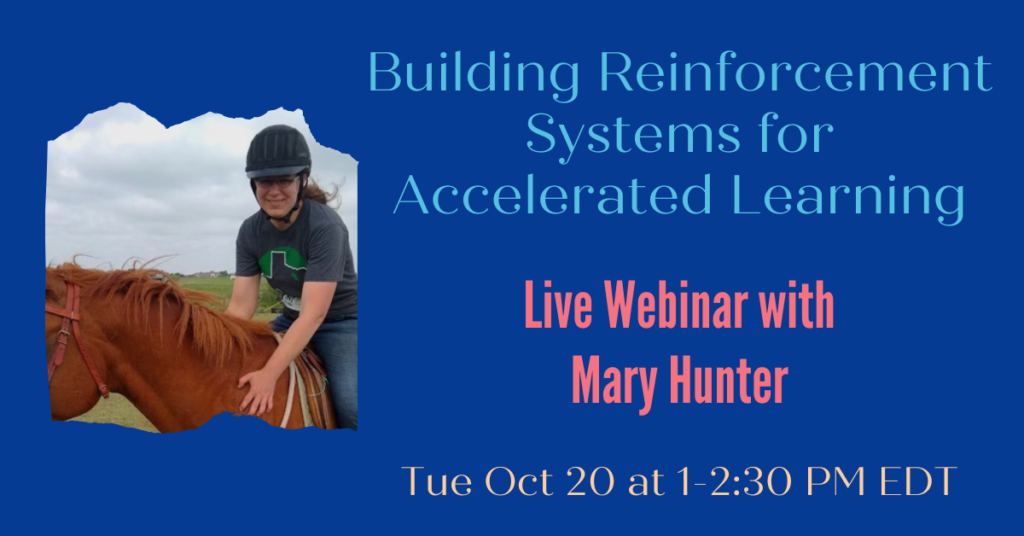
In this webinar with Mary Hunter, we’ll look closely at reinforcement systems and how they work. Taking the time to carefully design and teach new reinforcement systems can greatly expedite your teaching. As well, Mary will help you understand how to analyze and improve your existing reinforcement systems.
If you've previously registered for this webinar, please login to view it
This is a "pay what you can" webinar (from $15-$40). If you're not already a TAGteach member or have not yet had a free trial membership, you'll get 1 free month in the TAGteach Membership.
NOTE: this is 1.5 hour webinar

OVERVIEW
In this webinar with Mary Hunter, we’ll look closely at reinforcement systems and how they work. Taking the time to carefully design and teach new reinforcement systems can greatly expedite your teaching. As well, Mary will help you understand how to analyze and improve your existing reinforcement systems. The principles you'll learn here will be equally applicable to human and animal learners.
What is a reinforcement system?
A reinforcement system describes the back-and-forth interaction that happens between a teacher and a learner during the delivery of a reinforcer. At each step in the sequence, the teacher’s behavior cues the learner's next behavior. Likewise, the learner’s behavior cues the teacher’s next behavior. Their behaviors join together to create an interconnected chain.
Why are interconnected chains so important?
If there are breaks in your interconnected chain, progress will be much slower, and the value of your reinforcer will be diminished. Learning how to recognize and build reinforcement systems and interconnected chains will help you be more responsive to your learner, turning your training sessions into a back-and-forth conversation.
How do you teach a new reinforcement system?
Mary will share six steps that you can use to design and teach a reinforcement system as an interconnected chain. This process involves finding a suitable teaching environment, selecting a reinforcer, planning an interconnected chain, teaching your learner where and how to collect the reinforcer, adding a reinforcer signal, and finally utilizing your reinforcement system while teaching new behaviors. In addition to these core steps, you'll learn about common pitfalls to avoid when building reinforcement systems.
Throughout the presentation, Mary will share animal training video examples, as well as examples with human learners using the shaping game PORTL. These examples will help you better understand how reinforcement systems work and why taking the time to teach and improve your reinforcement systems can help accelerate your teaching.
BONUS WEBINARS - PORTL PARTS 1 AND 2
PORTL WEBINAR PART 1 - Basics of PORTL - FREE
Mary Hunter, one of the creators of PORTL explained the basics of shaping and of the game, showed us how to play and did a live demonstration with someone from the audience in Part 1 of this series. You will get Part 1 free when you register using the Register button on this page. Scroll down on the Learning Area > Webinars page to find it unlocked in your account. You must be logged in to see this.
PORTL WEBINAR PART 2 - Basics of Shaping - $10
In this webinar Mary elaborated further on the critical topic of shaping behavior with many examples and practice with PORTL. You will get the opportunity to purchase the recording of this for only $10 when you register using the Register button on this page.
Please note that these are a 1.5 hour webinars.
RECORDING
This will be recorded and all registrants will have access to the recording.
CEUs
No CEUs are provided
ABOUT MARY
Mary Hunter earned an undergraduate degree in biology from the University of Chicago and a master's degree in behavior analysis from the University of North Texas. She teaches people and their pets, working mainly with dogs and horses. In addition, Mary serves as president of the Art and Science of Animal Training. In 2019, Mary and Dr. Jesús Rosales-Ruiz published their first book, PORTL: The Portable Operant Research and Teaching Lab. Mary’s research interests include studying the process of shaping and finding better ways to teach people to train animals. She is a full member of the Association for Behavior Analysis International and has presented research at the organization’s annual convention.